Early Memories
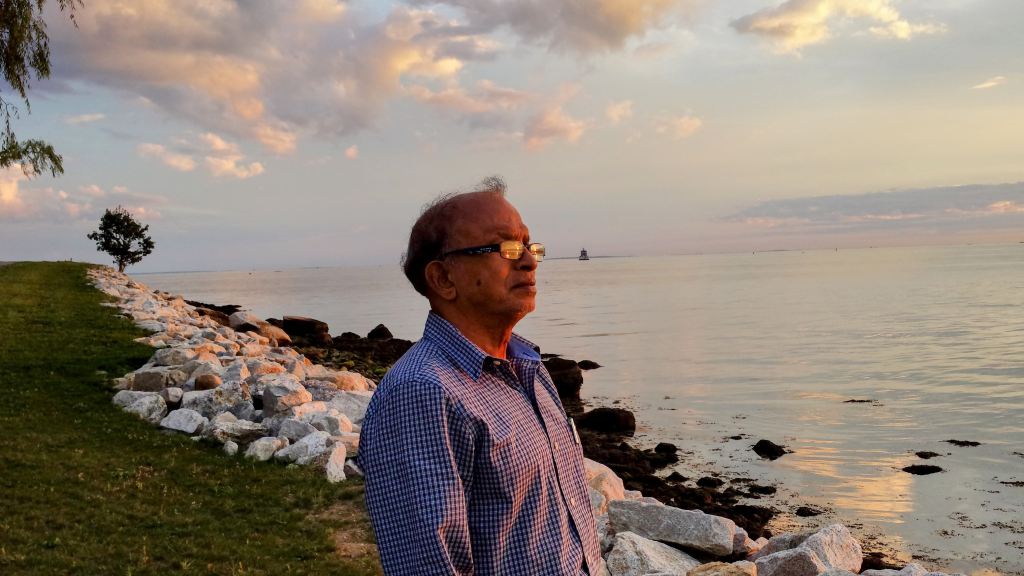
I have vivid early memories of Achchan (father in Malayalam) returning from the office, riding his bicycle, dressed in a half-sleeve shirt and bell-bottom pants. He sported a sideburn and a clean-shaven look back then. I remember him taking me to my first day of kindergarten. I sat on his bicycle while he walked alongside it. He waited patiently outside the school, even as I cried in the classroom on that daunting first day. The teacher eventually reassured him and sent him home. Just as precious is the memory of Achchan holding my hand as we walked to sports events at the stadium in front of our house – a simple gesture of connection we maintained even when I was in high school.
Sports
Achchan had a profound passion for sports since his youth, excelling in track and field, football, hockey, and volleyball during his schooling at St. Xavier’s, Tirunelveli, and S.N College, Kollam. On Sep 13, 1952, marking his 20th birthday, Achchan laid the foundation of the Attingal Amateur Athletic Association (AAAA), marking the beginning of his enduring commitment to sports.
Even during his college days, Achchan was an exceptionally sought-after referee, officiating both state and national-level football and volleyball matches. At just 23, he was refereeing at the national level, an unusually young age for an official in those days. I recall my uncle once mentioning an incident where the Circle Inspector himself visited their home. He specifically requested my grandfather to allow Achchan to referee a match involving the Kerala Police State team. They believed Achchan, known for his impeccable refereeing, was the only one who could prevent conflicts between the arch-rivals clashing in that day’s finals.
Achchan was always keen on introducing new games to our town and organizing championships, inviting teams from across the country. He successfully conducted national championships for Circle Kabaddi and Korfball. In the 1960s, he was one of the few selected for national training for athletic coaches, which gave him the opportunity to meet other national-level coaches and gain exposure to developments in sports at both national and international levels. He was particularly keen on exploring and introducing new games. Several sports like Kho-Kho, Circle Kabaddi, and Korfball were first introduced in Attingal by him and the Association he led. He even founded a new game called “Live-ball,” a three-touch version of soccer. He wrote the rules for the game and established a formal association for it, intending to introduce it to the world. In the 1990s, he wrote to FIFA about the game, but unfortunately, he never heard back. In the early 2000s, he worked with the organizers of Indoor Cricket, aiming to form a local team to participate in the Nationals, though that event didn’t ultimately take place.
Achchan wholeheartedly supported Amma (my mother) throughout her career in various sports disciplines. They traveled all over India when Amma participated in events like Handball, Kho-Kho, Kabaddi, and Arm wrestling. In 1982, they went to New Delhi to watch the Asiad Games. Achchan began preparations almost a year in advance, purchasing tickets and meticulously planning their travel and accommodation in Delhi, as it wasn’t easy to find lodging during the Games back then.
Achchan maintained the enthusiasm of a teenager for sports and games, even in the last years of his life. He never missed any sporting events on TV, especially the World Cup Football and the Olympics. He would often set the alarm and wake up in the wee hours of the morning to watch games, completely immersed in them. He would unknowingly cheer and give instructions to the players on TV, offering in-depth analysis of a player’s performance and what he thought would have improved the game if they had played differently.When I visited him last, I asked him what he would like me to bring for him. He said a pair of football boots and a jersey. Unfortunately, I couldn’t get them for him then, and I didn’t realize I would never have another chance.
SreepaAdam Stadium
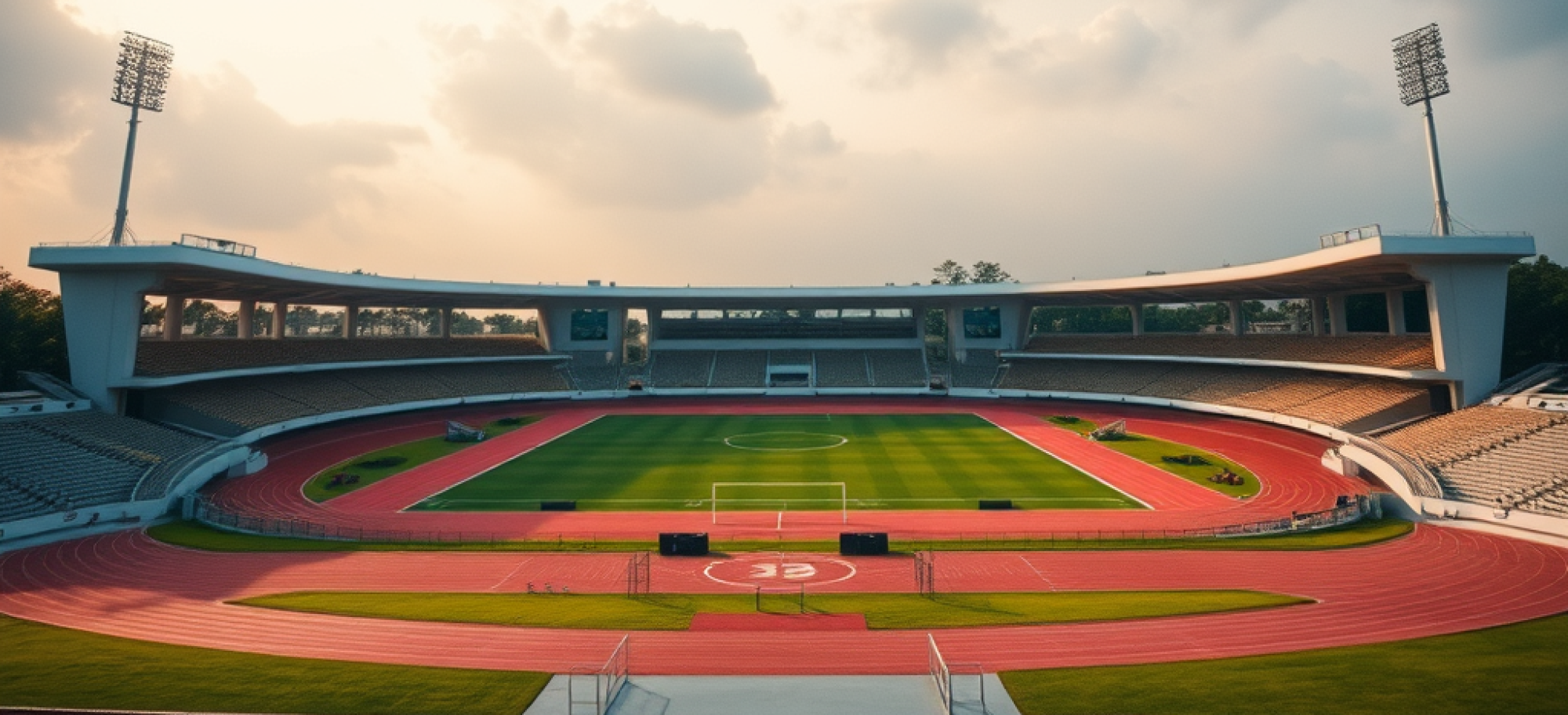
In 1959, Achchan and the association successfully petitioned Maharajah Sri Chithira Thirunal of Travancore for land, securing 8.5 acres of cashew plantation. Under Achchan’s leadership, this plot was transformed into a stadium featuring a 200m track and a football field. Since this land was part of the Sreepaadam lands, the stadium built there was aptly named Sreepaadam Stadium.
Achchan treated the stadium like his own child. I remember him picking stones with a bucket, and when it rained, he’d be out there with a spade, directing water off the field to prevent it from getting soggy. For every athletic meet, he’d single-handedly mark all the lanes for running, throws, and jumps using just rope and lime powder. I even remember helping him pitch the rope on the ground and walking slowly as we marked the lanes for the 100M and 200M races.
Every year, he’d reinforce the stadium’s fencing, tying old bicycle tires to the Sheemakonna trees planted around it. I remember that work taking a few days to finish. In the 80s, he collaborated with the Department of Forest to acquire hundreds of tree saplings. Our entire family then planted those saplings along the slopes outside the ground, so the grown trees would prevent erosion.
In his later years, he shared with me his plan to raise funds to develop the stadium into a world-class facility with underground parking, complete with a soccer field and a running track for athletics. His vision was to convert the stadium into a holistic health and sports training facility rather than solely a sporting arena. He also felt that the students should live with their families so they wouldn’t be stressed by living away from home. Unfortunately, his plans could not take shape due to some legal issues that arose in 1984 and continued for four decades.
Health and Discipline
Achchan was very keen on the health and well-being of us kids. He made us do calisthenics when we were young and taught me some basic gymnastics, such as somersaults, cartwheels, and rope climbing. He himself was a gymnast and used to perform on parallel rings during his younger days in college. During his school and college years, he participated in and won events like long jump, football, and field hockey. He later mentioned that he hardly received any instructions on long jump techniques but managed to jump more than 20 feet during his college days.
Achchan was always careful about his health and particular about his diet. I heard a story that one day, for some reason, there was no mutton, which he insisted on having daily. In protest, he locked the kitchen and left the house. Ironically, he later stopped eating meat entirely when his favorite rooster was stolen, obviously for its meat.
He stayed active by walking or biking 2 km to town, and doing chores like splitting logs and carrying water in buckets for the plants. He used to be a fast walker and I remember some of our neighbors commenting how fast Achchan walks. He maintained a consistent body weight until his last few years. When I used to call him, one thing he always enquired about was whether I was exercising regularly. To avoid lying to him, I made sure to do some daily stretching, push-ups, and sit-ups, which also helps me stay moderately fit. When we were in school, he wanted my sister and me to participate in sports. He encouraged us to compete in games and athletic events in our school and later during college. I remember him hiring an auto-rickshaw and following me during the 12 km cross-country race conducted by Kerala University. He made sure I finished the race, which was my first cross-country race, and the first time I had run that distance in my life!
He also came to various soccer games I played at school and college levels. I never had soccer boots until high school. I remember him taking me to a sports equipment shop in Thiruvananthapuram and buying me a complete kit, including stockings and shin pads. He taught me how to lace the boot and tie it under the sole so that it stayed on my feet during the game. As an athlete himself, when wearing football stockings, he always made sure no lint or other particles stuck to them. That attention to detail of an athlete was evident in other areas of his life. He believed in the benefits of meticulous planning, be it for a sports event or other day-to-day activities.
Leadership
I found Achchan to be a natural leader. I had seen him rise to the occasion without being asked to help, whether it was listening to someone’s problems and helping them solve them, or small things like replacing fused streetlights, building a new road in my mother’s hometown or saving a suffocating dog caught on its chain. He had a good command of the English language and was always a language enthusiast. He had a large collection of books, mainly on sports, but also on topics ranging from history to computers. He enjoyed writing his speeches for the monthly meetings of the Lions Club, where he served as Secretary for a period. As the Founder Secretary of the Attingal Amateur Athletic Association, he meticulously maintained records, meeting minutes, and conducted meetings regularly. He often worked late into the night, preparing meeting invites for the association or the charitable hospital. He also held the leadership positions of several state sports organizations like Kerala State Bowling association and Kerala State Powerlifting association. I always wondered where he drew the motivation and energy to get involved in so many activities. I realized it was his passion for sports and unwavering determination to see the Association and his team reach the next level that drove him. He was active in the Bharat Scouts and Guides and conducted several events in our town and attended national camp held in New Delhi in the 80s.
He always believed in doing the right thing, even when no one was watching. While my sister and I were kids, I remember him telling us about civic duties like keeping public places clean by not spitting or littering, giving up seats to the elderly on a bus, and holding the door for others. He was a non-smoker and a teetotaler throughout his life. Until his retirement, he used to bicycle to his office at the Attingal treasury. While working at the Thiruvananthapuram Secretariat, he once bicycled 70 kilometers round trip to the office, rallying for the rationalization of the pension age for state and central employees. This was covered by local newspapers, including “The Hindu.” He always believed that everybody should have the right to work until they wished to. He felt that having different retirement ages for state and central government employees was not right. He met the then Governor, Shri P. Ramachandran, and submitted a memorandum for rationalizing the retirement age to 60 instead of 55. As there was no action from the State government, he filed suits at the High Court and later the Supreme Court for the same cause. When he retired, he refused to apply for his pension. Eventually, after five years, his pension was granted based on my mother’s application. The State government later raised the retirement age to 56 in 2012.
He was a visionary and constantly thought of ways to improve things. In the early 1990s, he prepared a memorandum of more than 50 pages requesting the then Chief Minister, Shri. K. Karunakaran, detailing the need for a coastal elevated highway stretching the entire coastal region of the state of Kerala. The memorandum also contained improvement plans for other areas. He never took “no” for an answer and kept pushing for results. An average person would have given up, whereas he kept pursuing the goals he thought were right for him and the community.
When it comes to persevernce, I haven’t seen many people as persistent as my father. I’ve seen him relentlessly continue despite several setbacks in his efforts to defend the things and ideas he dedicated his time and effort to, like the stadium and the charitable hospital.
His Love for Dogs
Achchan always loved dogs, and we always had them in our house while growing up. Our first dog, Sanjayan, was a German Shepherd. Sanjayan used to wait for Achchan to return from the office and would run towards him when he came home on his bicycle from the other side of the stadium. Achchan was so worried and concerned when Sanjayan fell ill. He even telegraphed to Calcutta for his medicines. Unfortunately, Sanjayan died before the medicine arrived. Achchan was devastated. He buried Sanjayan and lit lamps at his burial ground as if Sanjayan were a person. He even conducted the “Kanji veezhthu” (a ritual performed on the fifth day after a death) on the fifth day of Sanjayan’s passing. My grandfather (Achchan’s father) was living with us at that time. One of his colleagues, who was passing by, saw the lit lamp and thought my grandfather, his friend, had passed away. After Sanjayan, we had a few more dogs: August, Maya, and most recently, Balu. All the dogs were treated like family, and Achchan was deeply saddened when they passed away.
DISTINCT STYLE AND PERSONALITY
From my childhood, I noticed he wanted to do things differently. This character of standing out reflected not just in his words and actions, but even in his sense of style. He had several bespoke suits custom-made by our tailor, Santha Tailors. Also, in the early ’80s, he sported the biggest sideburns I had ever seen. When it came to picking clothing for shirts and pants, he never settled for the normal or the subtle; it was always the fanciest patterns and colors. He often wore suede shoes and dress boots, which weren’t common sights back then. I remember him taking me to Babu Stores in Attingal when I was leaving for college. He got me four pants and six shirts and gently nudged me to pick some bright colors and fancy patterns. I settled for one red shirt just to keep him happy.
Achchan appeared to be a serious person to many, but he was always loving toward my sister and me. When I asked for something, he never said no, even when I knew it might be a stretch for him financially. Once, in middle school, after learning to ride a bicycle, I asked for one. He said he would try to get a new one for me. Eventually, I ended up riding his bicycle, as he stopped using it after he retired from his job at the State Treasury. At times, his short temper overshadowed his kindness, a side very few who knew him closely got to see.
He had a very strong will and at times seemed very adamant. There was a funny incident that showed just how strong his will could be. It was the day my sister, Uma, had to go to Thiruvananthapuram Women’s College for her admission. Achchan was particular about Rahu Kaalam (an inauspicious time according to Indian astrology) and made sure he never left the house during it for any important matters. However, on that particular day, they were late and couldn’t leave before Rahu Kaalam began. So, Achchan went and moved the minute hand of the clock backward and then left the house!
Sense of HUMOR and LOVE for MOVIES
Achchan had a great sense of humor, always ready for a good laugh, often at his own expense or others’. Wit ran in our family, a trait he shared with my grandfather. When with extended family, he’d playfully tease his cousins and crack self-deprecating jokes, as long as everyone enjoyed the laughter.
He loved movies. I have fond memories of him taking my sister and me to the nearby Gauri theatres. In his college days, he was particularly fond of Tamil action films featuring horse races and swashbuckling heroes like MGR and Sivaji Ganesan. Later, we never missed a Rajinikanth movie, and he’d always take us to watch them.
Meeting Amma
Shri. Bhashyam, the son of Krishnan Vakeel, was Achchan’s childhood friend and classmate. They lost touch after school but reconnected in the early 1990s. In 1993, Bhashyam Sir invited Achchan on a trip to Vallikavu to see Mata Amritanandamayi, affectionately known as “Amma.” This was a turning point in Achchan’s and our lives. Achchan was so moved by Amma’s darshan that he was eager to take us all to Vallikavu. He soon became a devotee of Amma. He went to the Ashram several times and attended Bhavadarshanam, where Amma gives darshan (audience) as the Devi (goddess). He used to make sure we sat at the front of the auditorium early for the bhajans. He had taken some lessons on an instrument called the Bulbul in his younger days, but I had never heard him sing. Going to the Ashram changed that; he started singing along during bhajans and sat on the floor with legs crisscrossed for several hours until the Devi Bhava ended in the early mornings. He took the initiative to conduct Satsangs at our house on Saturdays. He started chanting the 108 names of Amma and the 1,000 names of Lalitha Sahasranama daily. If one asks me what is so special about Amma, I would say the changes I saw in Achchan were nothing short of a wonder.
Achchan was so enthusiastic about Amma and the Ashram that he went ahead and corresponded with the Wildlife Department to arrange the purchase of three deer fawns for the Ashram. Unfortunately, the Ashram didn’t have the facilities to keep them at that time, and the plan was dropped. Achchan once arranged a bus for our neighbors and his friends because he wanted them to visit the Ashram and meet Amma. He wanted them to experience the same joy and happiness he had when he met Amma. He became active by attending Satsangs and Amma’s programs, never missing a chance to talk about Amma when he met someone. This was a surprise to most people, given that he came from a family of Communists. He met Amma at the Ashram for the last time in 2022 and received her Darshan. I was lucky enough to spend a few weeks with him during his last days. During those days, he used to listen to Amma bhajans and went to sleep while they played.
Relation with the Travancore Royal Family
Achchan had the opportunity to meet the Maharajah, Sri Chithira Thirunaal, when His Highness visited Attingal for the Ariyittuvaazhcha Festival at the Royal Family’s temple. My father used to organize the welcome party for the Royal family during those occasions by putting up arches throughout the town. He also got the opportunity to meet Col. Godavarma Raja, who was the Maharajah’s brother-in-law and a sports aficionado. Through these connections, Achchan requested the Maharajah and Royal family to grant some land for the development of a stadium in Attingal. To everyone’s surprise, the request was granted, and 8½ acres of land with cashew trees was given as a gift in 1959, with the condition that it be developed into a stadium within two years. The land was gifted to the Attingal Amateur Athletic Association, a non-profit sporting organization that my father founded on his 20th birthday in 1952.
My father went ahead and established the Sri Chithra Coaching School, which produced world-class athletes from Attingal, including his wife and my mother, Rema Unnikrishnan. Achchan was the second eldest of ten kids. He enrolled all his younger siblings in the Coaching School and made sure they participated in various sports and games. He organized transportation, jerseys, and food for the training school students to participate in various tournaments and sporting events. Most of the time, the expenses were borne out of his own pocket.
He considered Col. G.V. Raja as a mentor and father figure. My father addressed him as Colonel Thirumeni and always consulted him on the plans and developments for the Sreepadam Stadium, which Achchan and the association built using the land gifted by the Maharajah. Achchan was devastated when Colonel Thirumeni passed away in a tragic plane accident in Kulu on April 30, 1971. Achchan mourned Thirumeni’s passing by sporting a beard for a year. On the first death anniversary of Col. G.V. Raja, a Sports Festival was organized by Achchan and the Association in Sreepadam Stadium. The torch for the games’ opening started from Thirumeni’s birthplace, Poonjar Palace, and was carried by several athletes covering many kilometers before finally entering Sreepadam Stadium. He named me after G.V. Raja; when my name, Girija Vallabha Raja, is initialized, it reads G.V. Raja.
Achchan’s relationship with the Maharajah and the Royal family also resulted in receiving a grant to start a charitable hospital in Attingal, namely Sree Padmanabha Swami Charitable Society. As usual, I remember Achchan tirelessly working for the setting up of the society and managing the day-to-day operations of the hospital. He used to ride his bicycle from our home to the hospital several times a week to attend to various activities related to its management. The charitable hospital still operates with grants provided by the Royal family of Travancore.
He was always grateful and loyal to the Maharajah for the stadium and the charitable hospital His Highness had gifted to Attingal. Moreover, Achchan and the Maharajah shared the same birth star, “Chithira,” which made him feel a special connection to His Highness. When the Sree Padmanabha Swami Charitable Society members, including himself, were invited to the palace, Achchan arranged large quantities of tender drumsticks and halved tender cashews, knowing that His Highness and the Royal family loved Theeyal dish made of drumsticks and tender cashews. It was public knowledge that Achchan was a great admirer of His Highness, and once someone made a prank call to his office and told him His Highness had passed away. In shock, Achchan hurriedly left for home and called others, only to find out it was a prank call. When my mother won second place in the World Arm Wrestling competition in 1980, the palace awarded her a cash prize. All the members of the Attingal Amateur Association attended that function, and we all still cherish those moments captured in pictures.
Recently, while I was visiting my parents, we sat outside the house talking about Achchan’s younger days. He talked about his schooling at LMS Lower Primary School, BTS and Boys High School. He spoke fondly about one of the professors from St. Xavier’s, Trichinappaly, who encouraged him to play basketball. He talked about his athletics coach, Bhaskaran Nair at Kollam S.N. College who trained him in long jump. He told me about the Travancore national anthem, Vancheesamangalam, and how he used to sing that every day at LMS Lower Primary school. I played the song on my phone, and he was so moved by it that he sang along a few lines and said, “Ente Rajavu (My King)”
 Attingal Amateur Athletic Association