The life and legacy of D. Unnikrishnan
Girija Vallabha Raja Kumar (Giri)
Malayalam translation and adaptation by Kannan Bose CB
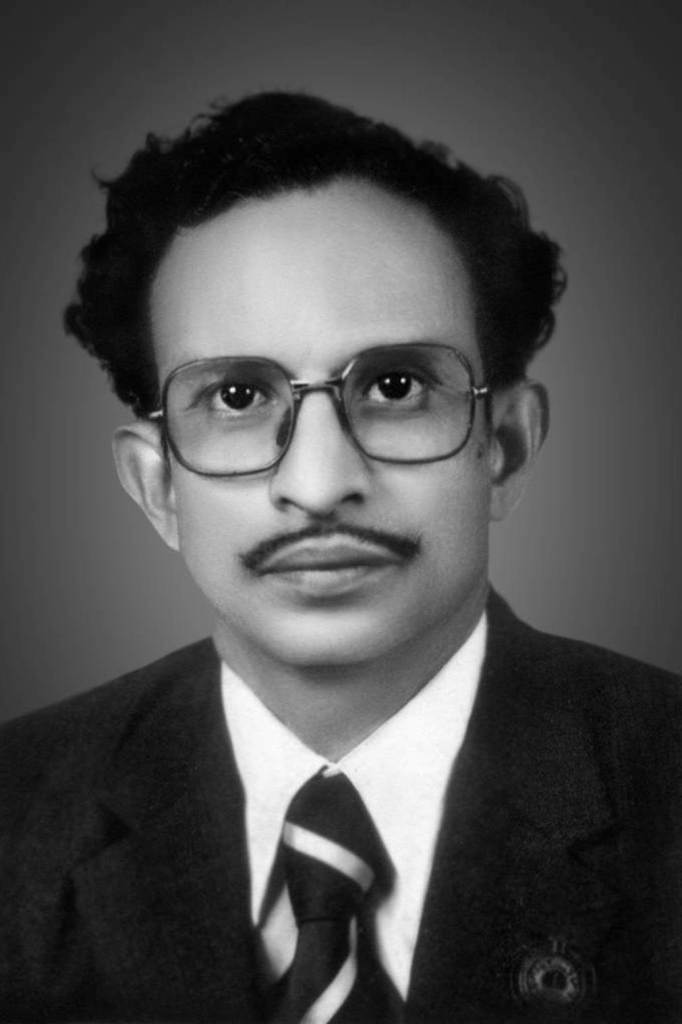
A cover image of cherished memories
Dedication
To my father, who taught me love, discipline, service to society, and the strength of commitment through the great school of life.
The life he lived will not remain only in one family’s memory; it will continue to shine in the hearts of a community and in the dreams of a generation.
Introduction
Some people become pillars of a family. Some become pillars of a community. Very rarely, a few transcend both and leave their mark on an entire generation.
My father, D. Unnikrishnan, was one such man. His life cannot be defined in a single word.
He was an athlete, coach, referee, government official, public servant, social reformer, and spiritual seeker. Yet none of these titles fully captures who he was.
He was a rare man who devoted his life to a dream, fought for decades for a cause, and served society without expecting anything in return.
Though he left us on July 25, 2024, the values he lived by continue to echo in the lives of many people today.
These memoirs are not a biography, but a collection of memories I carry in my heart. They are not only about my father, but also about the time and world he belonged to.
Chapter 1
Childhood and the calling of sports
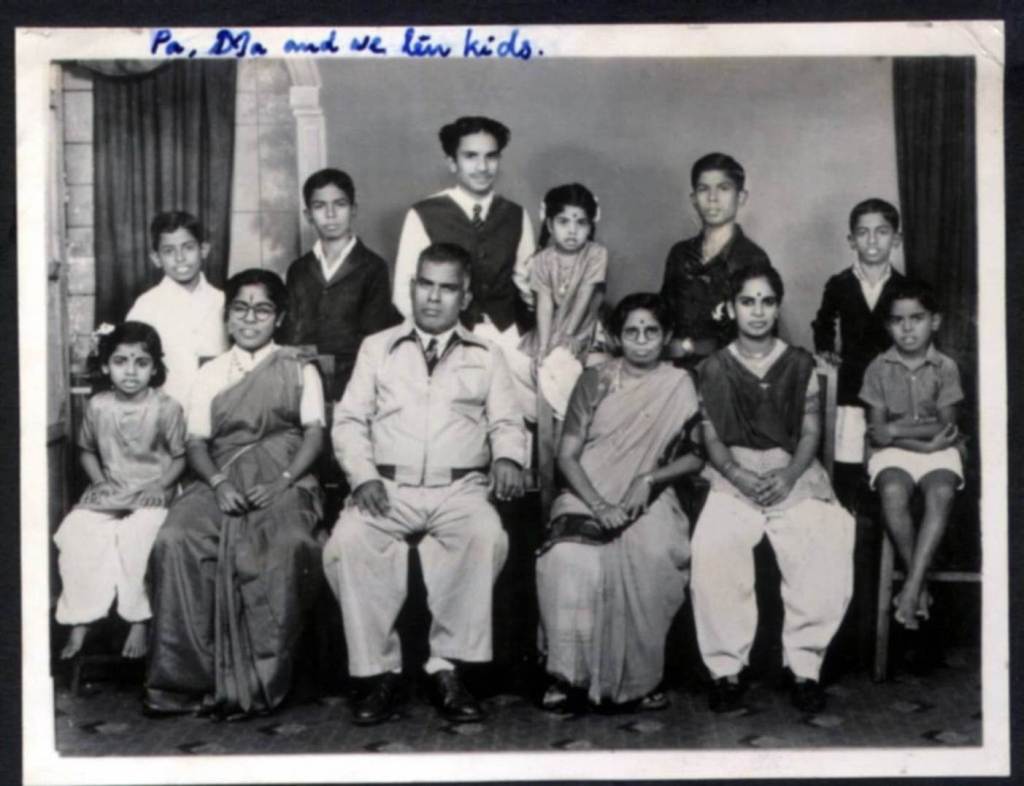
An old photograph of my father, standing in the middle of the top row, with his parents and nine siblings.
D. Unnikrishnan was born on September 13, 1932, at Cannaught House in Attingal, to Advocate Damodaran and Ratnavalli. At the time, no one could have imagined that he would one day help shape the sporting culture of an entire town and touch the lives of hundreds.
From a very young age, he showed an extraordinary passion for sports. St. Xavier’s College in Tirunelveli and later S. N. College in Kollam became the institutions that shaped and advanced his sporting journey.
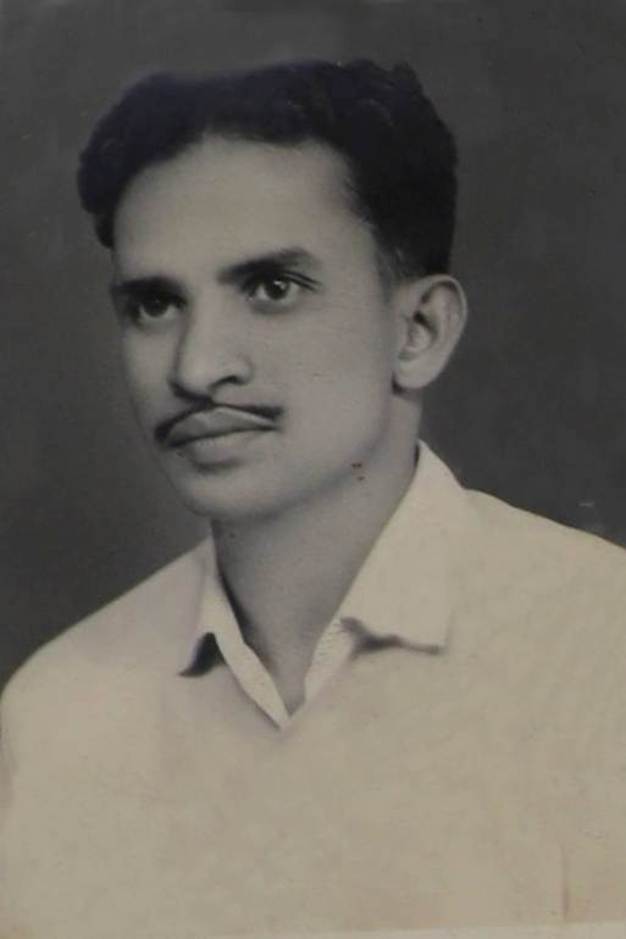
He discovered his future in track and field. He was equally drawn to football, hockey, athletics, and volleyball, and believed that exercise and competitive sports were among the best ways to build a healthy person, both physically and mentally.
It was there that the ideas guiding the rest of his life began to take root. He believed sports were a school that trained not only the body, but also the mind, character, and sense of social responsibility.
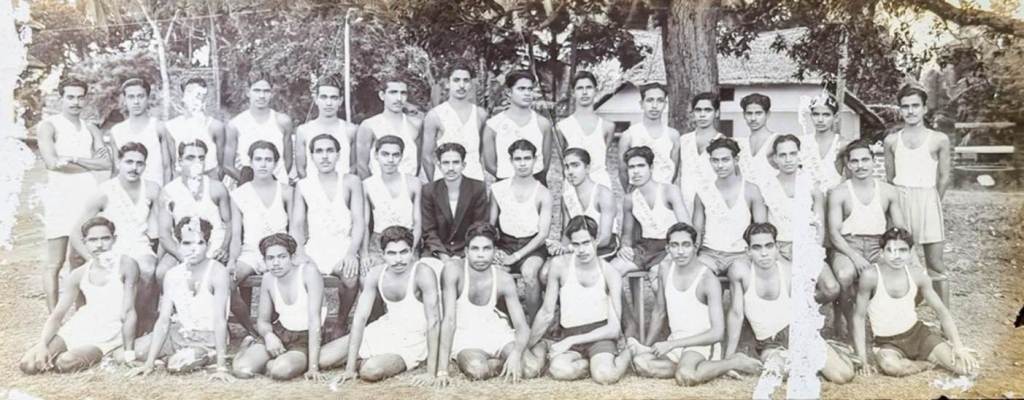
My father with his athletics team in the 1950s.
Chapter 2
A movement that began at twenty
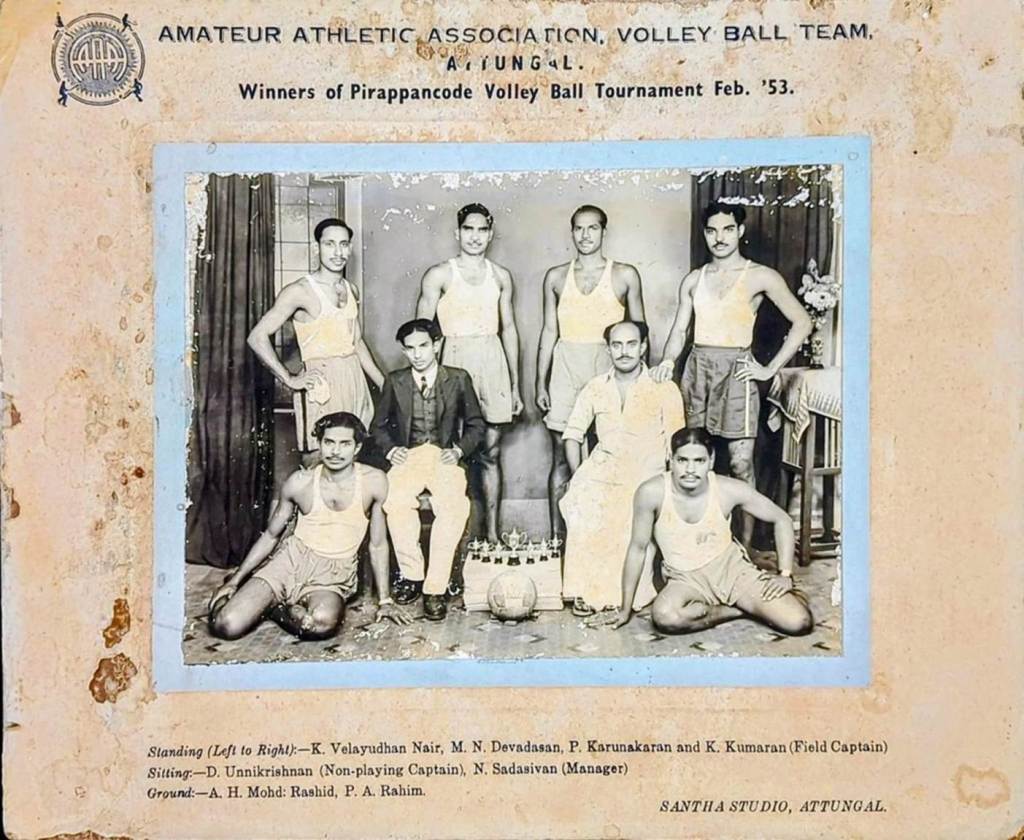
A photograph recalling the early days of my father’s sporting career.
September 13, 1952, was my father’s 20th birthday, an age when most young people only think about their own future. But on his 20th birthday, my father started a sports organization, the ‘Attingal Amateur Athletic Association’.
That day, he started not just a club. It was also a community’s sporting culture. He firmly believed that sports could pave the way for the social progress of a village or town.
Many sporting activities that seem natural today were very rare at that time. There were no stadiums, no infrastructure, no sponsors. There was only one man and his determination. That was what later changed the sporting history of Attingal.
It was through the efforts of him and his colleagues that Attingal was introduced to and nurtured many sports, including Kho-Kho, Circle Kabaddi, Korfball, Handball, Volleyball, Swimming, Wrestling, and Arm Wrestling.
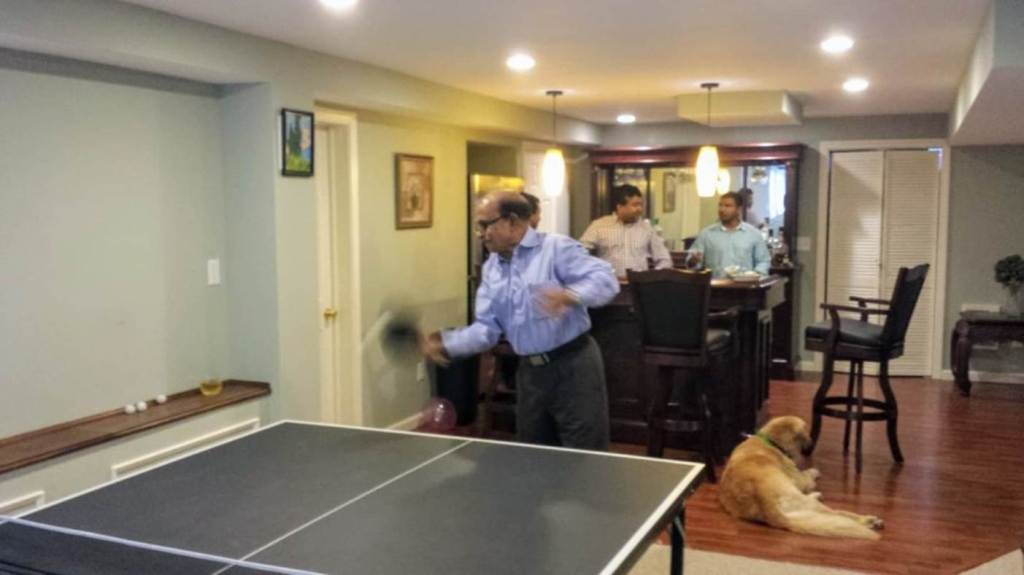
My father plays table tennis at the age of 81.
Chapter 3
Sreepaadam Stadium – a lifelong dream
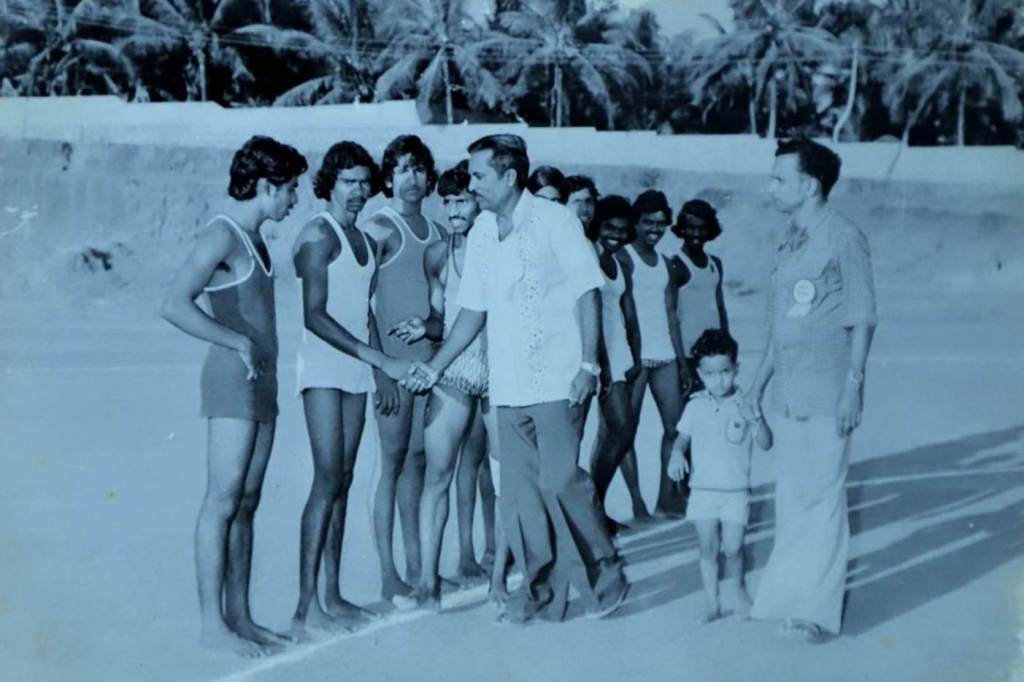
A picture taken with my father during a sporting event at the Sreepaadam Stadium.
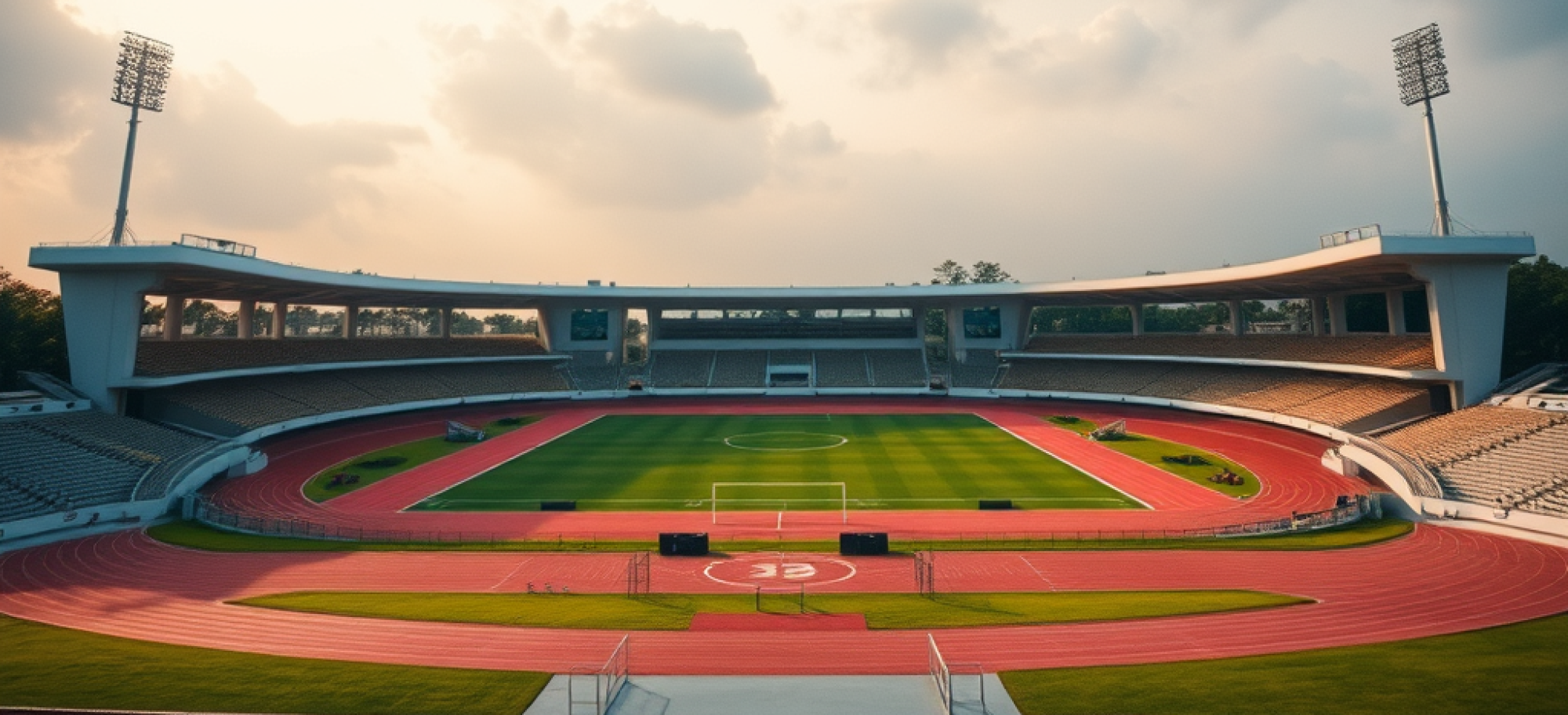
Some buildings are made of concrete; others are built from love and sacrifice. Sreepaadam Stadium belongs to the latter.
My father’s greatest dream was to see a proper stadium in Attingal—a place where children and young people could grow in health, confidence, and discipline.
The real challenges began after the land was acquired. It took years of steady effort to turn the rugged hills and cashew-covered surroundings into a sports arena, and my father was at the heart of that work.
I have seen him rush out during the rains to clear waterlogging, remove stones from the field, and mark the tracks and paths himself with ropes and chalk dust for running, jumping, and throwing.
He cared for that land not as a piece of land but as his own child. The Sreepaadam Stadium was not a construction project for my father. It was the manifestation of his philosophy of life.
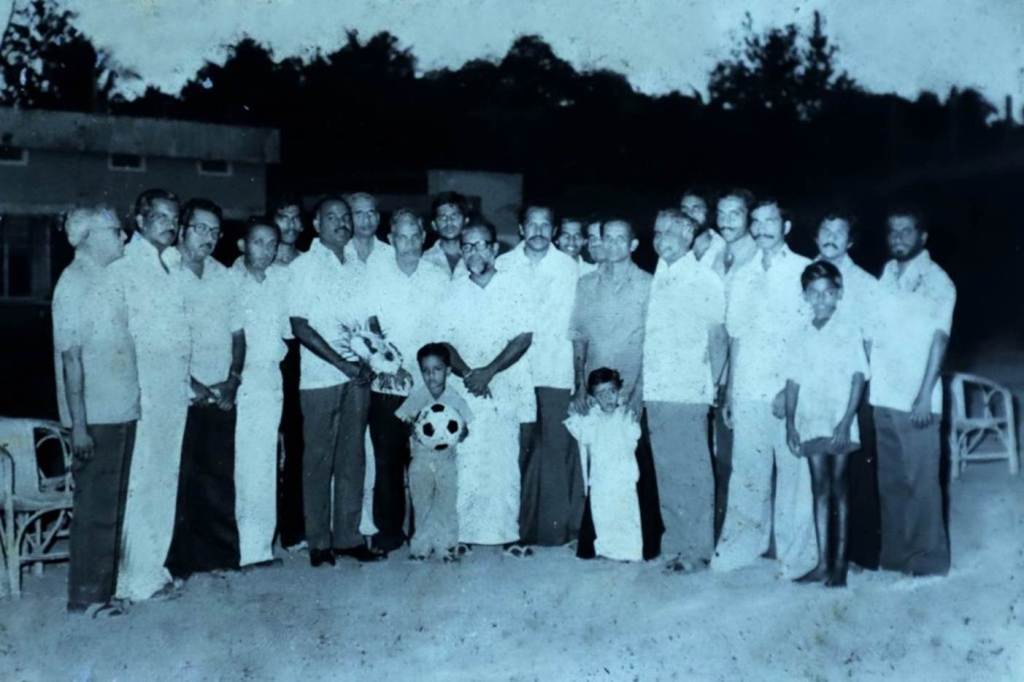
At the inauguration of a Korfball coaching camp at Sreepaadam Stadium.
Chapter 4
The Travancore Royal Family and Colonel Thirumeni: A close bond
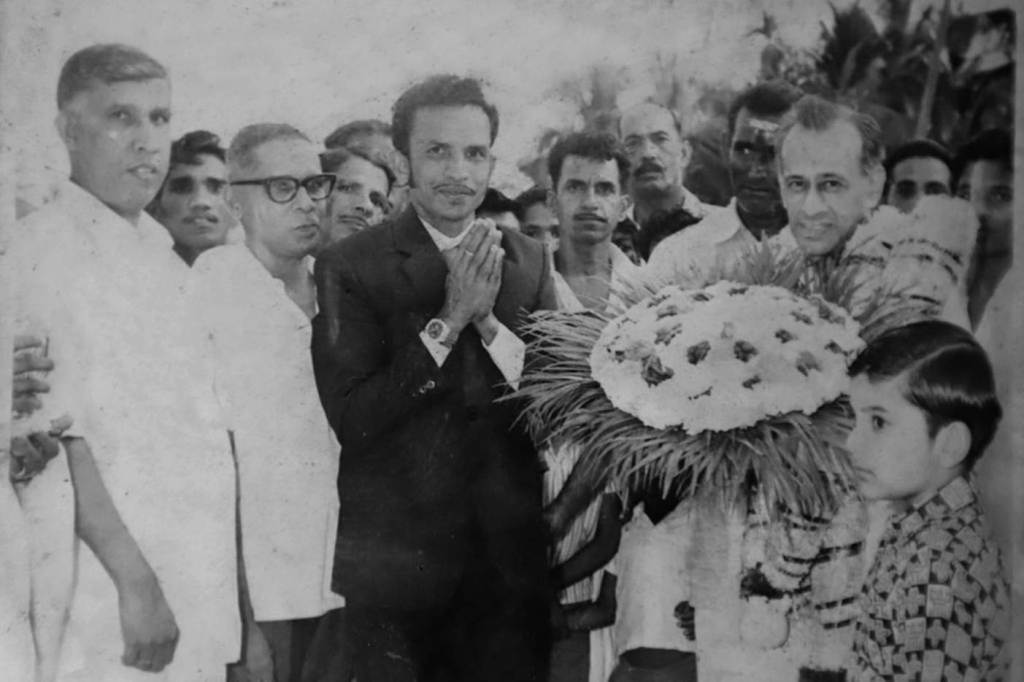
The reception to Maharaja Sri Chithira Thirunal when he came for Ariyittu Vazhcha ceremony in Attingal
Among the important relationships in my father’s life, his bond with the Travancore royal family can never be overlooked. It was far more than a formal acquaintance or social connection; over time, it grew into a personal relationship built on mutual respect and trust.
Colonel G. V. Raja, a visionary leader and great patron of sports, had a deep influence on my father’s life. My father saw him not merely as a member of the royal family, but as an elder brother and mentor whom he loved and respected. Until the end of his life, he addressed him as “Colonel Thirumeni.”
My father shared his dreams for building a sporting culture in Attingal most openly with Colonel Thirumeni. Whether he was planning a new tournament, introducing a new sport, or imagining the larger dream of a stadium, he would discuss his ideas with him and seek his guidance.
I have heard my father’s contemporaries say that whenever Colonel G. V. Raja and my father spoke about sports, their eyes would light up. They were united by the belief that sports could be a powerful force for transforming society.
On one occasion, when members of the Travancore royal family visited Attingal, my father had the opportunity to meet Maharaja Sree Chithira Thirunal in person. He used that moment to speak sincerely about the social value of sports and the need for a proper stadium in Attingal, where young people could receive good training and help bring about a new era in sports.
His sincerity and vision must have moved the royal family. In 1959, about eight and a half acres of land owned by the Valiyakunnu Palace were allotted to the Attingal Amateur Athletic Association. That land later became the present-day Sreepaadam Stadium.
My father regarded this as one of the greatest honors of his life. The land was not a personal gift to him, but a gift to Attingal’s sporting future.
For many years, Sreepaadam Stadium and the Attingal Amateur Athletic Association played a vital role in developing Attingal’s sporting talent, building strong teams, and winning many medals and trophies.
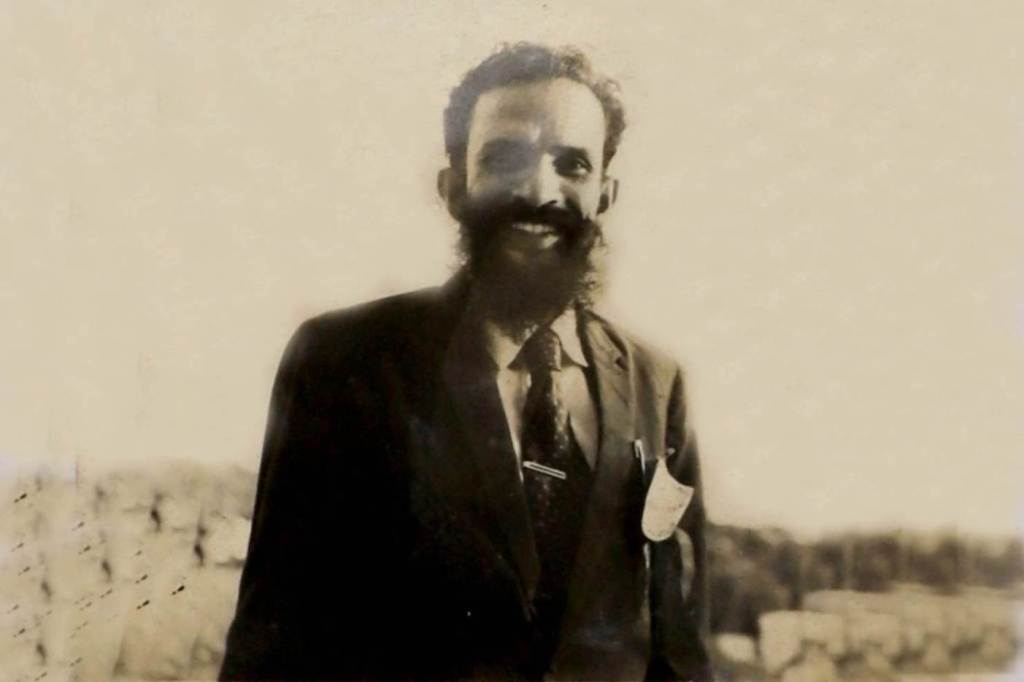
In 1972, during the Kerala Sports Festival held in memory of G.V. Raja
The news of Colonel G. V. Raja’s tragic death in a plane crash in 1971 left my father profoundly saddened. Family members and friends still remember that he grew a beard for nearly a year as a quiet expression of his grief.
The sports festival held at Sreepaadam Stadium on Colonel Thirumeni’s first death anniversary became another symbol of my father’s deep affection for him. The torch, carried by several athletes from Poonjar Palace to Sreepaadam Stadium, was more than part of a sporting event; it was a disciple’s tribute to his guru. Many who were present later recalled that, as the torch entered the stadium, a sudden small whirlwind rose and swept dust across the ground. To them, it felt like the presence of Colonel Thirumeni’s spirit.
Another beautiful sign of my father’s respect for Colonel Thirumeni is found in my name: Girija Vallabha Raja. Its initials form “G. V. Raja.” As a child, I thought this was a coincidence, but later I understood that it was not. The name was my father’s quiet tribute to the man he loved and respected so deeply.
My father spoke of Sree Chithira Thirunal Maharaja with great reverence. He believed that institutions such as Sreepaadam Stadium and, later, Sri Padmanabhaswamy Charitable Hospital would not have become possible without the royal family’s support.
He would also mention with delight the small coincidence that both he and the Maharaja were born under the star “Chithira.” It may have been only a historical curiosity, but to my father, it symbolized a bond of affection.
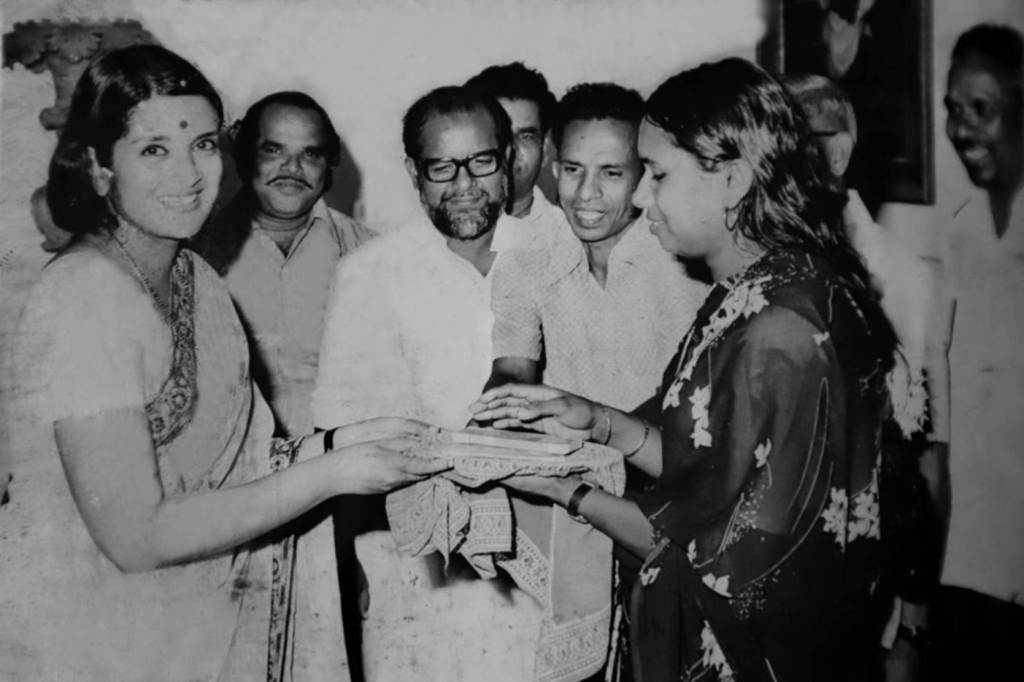
My mother, who won second place at the 1980 World Women’s Arm wrestling Championship, being felicitated at the Travancore Palace.
Chapter 5
A coach who touched hundreds of lives
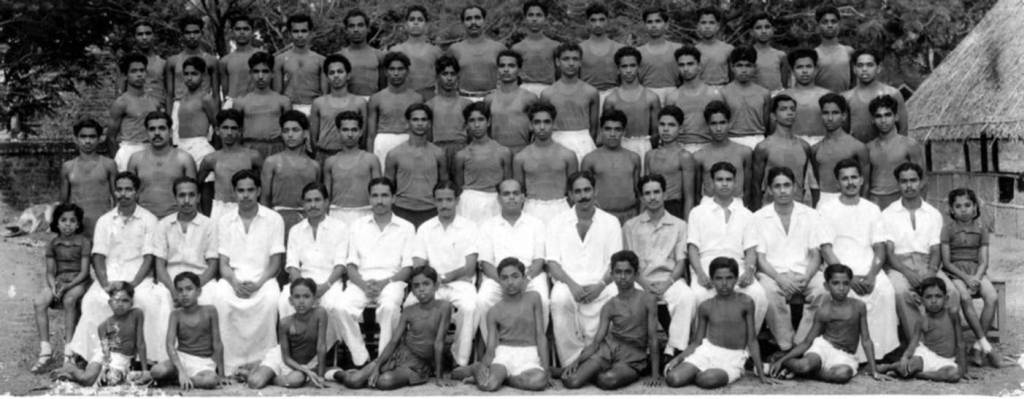
Students at Sree Chitra Coaching School
The success of a teacher or coach is often seen in the achievements of students. But to my father, a coach’s greatest accomplishment was helping students become socially responsible and compassionate human beings. Sree Chitra Coaching School stood as a living example of that belief.
He made it a habit to identify children from economically disadvantaged families and create opportunities for them. As far as he could, he provided food, jerseys, travel, accommodation, and training. For him, sports were not merely a field of competition; they were a path to social transformation. For many, sports opened the door to government jobs, built confidence, and changed lives.
His selfless efforts helped many students secure jobs through sports quotas in departments such as the Railways, Food Corporation of India, Income Tax, Postal Service, Police, and Excise. He brought the same sporting ideals into his own family, offering support and encouragement that helped many relatives, including my mother, Rema Unnikrishnan, grow in the field of sports.
Chapter 6
A life devoted to public service
For him, community service was not an obligation or a path to recognition; it was a way of life.
Even while serving in the State Treasury, and later after retiring as Assistant Director, he continued to dedicate time to the community. His government career was only one part of a much larger life of service.
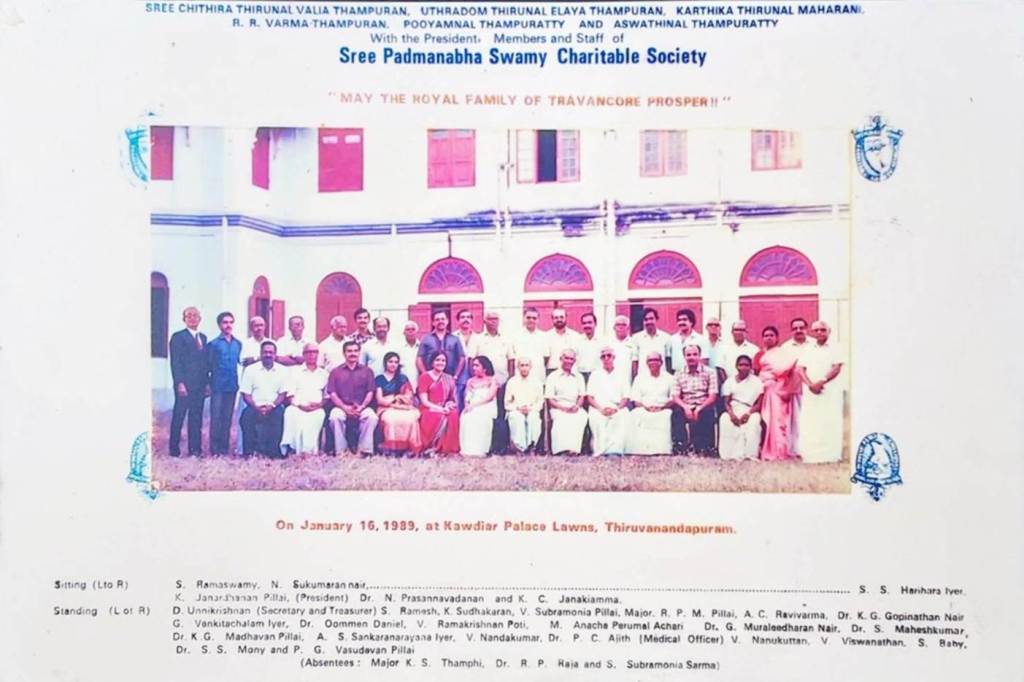
Members of the Sree Padmanabhaswamy Charitable Society visiting the royal family.
He played a key role in establishing and running the Sree Padmanabhaswamy Charitable Hospital, with the goal of making medical care accessible to all and improving public health.
He also never hesitated to stand up for public rights or involve himself in social causes.
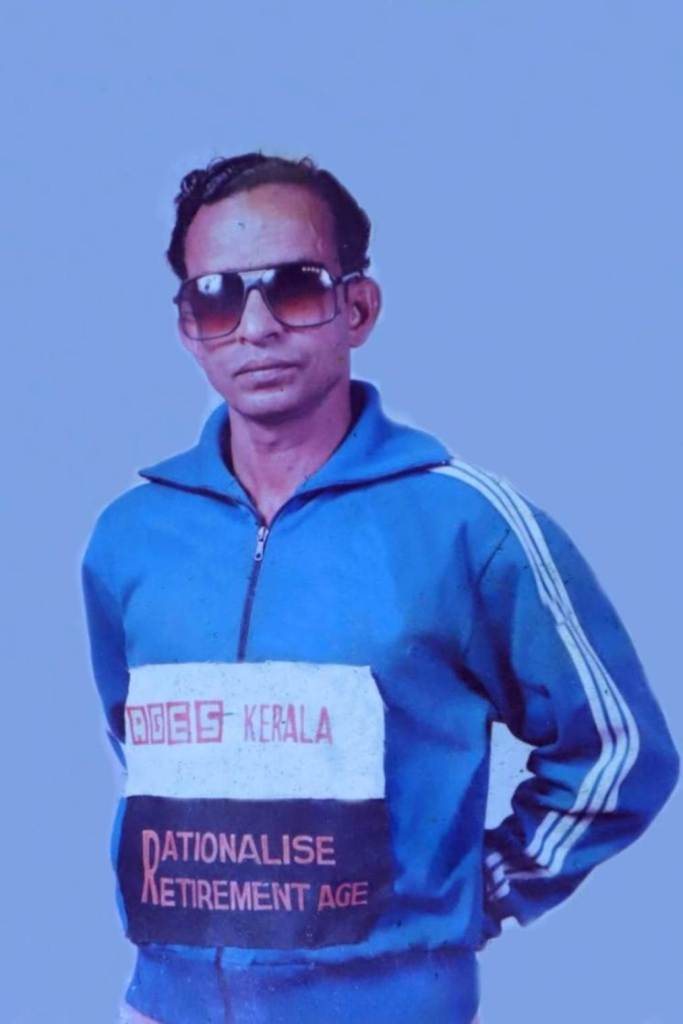
A one-man bicycle rally from Attingal to Thiruvananthapuram calling for a uniform retirement age.
His legal fight against the difference in retirement age between state and central government employees was also significant. At the time, my father undertook a one-man bicycle rally from Attingal to Thiruvananthapuram, demanding a uniform retirement age. The rally received prominent coverage in several newspapers, including The Hindu.
Many of his struggles did not succeed, but he never gave up. For him, standing up for what he believed was right—for himself and for society—mattered more than winning.
Chapter 7
The father I knew in childhood
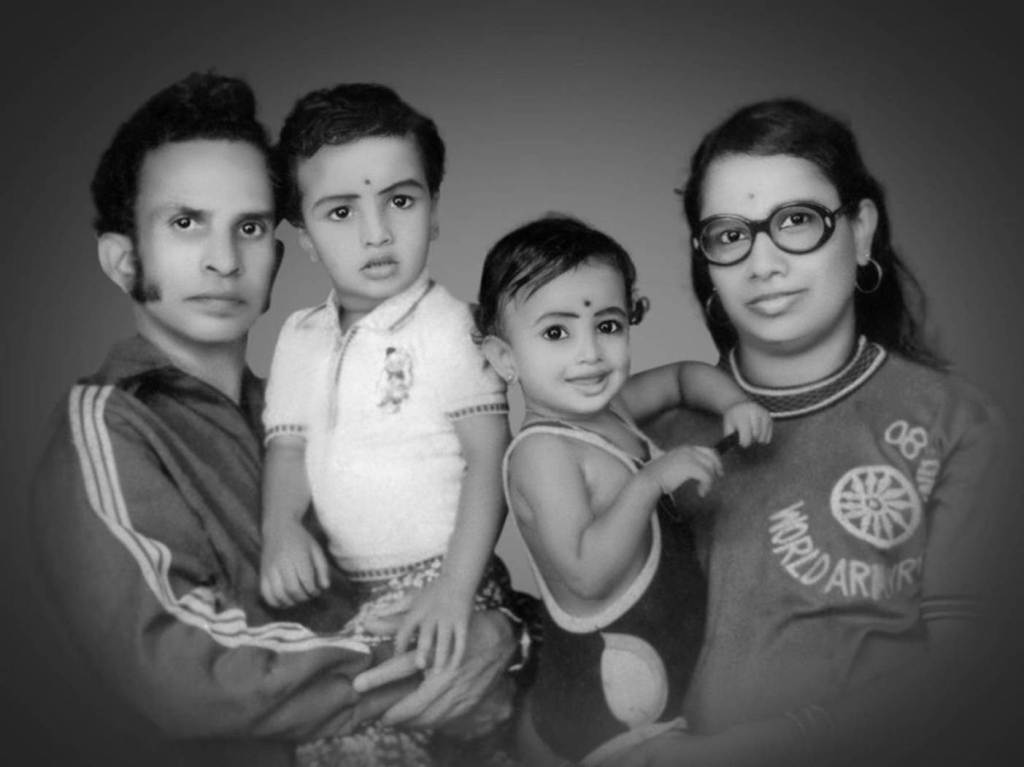
A photograph of family memories.
The father I knew was very different from the man others saw. On my first day of school, while I cried in fear inside the classroom, he waited anxiously outside instead of going home. He was the one who took me to school and brought me back by the hand. Later, during our morning and evening rides through the stadium in front of our house, he taught me many life lessons. He was also the first to celebrate my successes and comfort me in my failures.
I can still clearly picture my father following me in an autorickshaw when I took part in a cross-country race. During school exams, he would stay awake through the night while I made my last-minute preparations. I did not understand then how much a parent’s quiet presence can strengthen a child’s confidence. I understand it now.
Even during the walks and conversations we shared until high school, my father’s love was never loud; it was always a warm and steady presence.
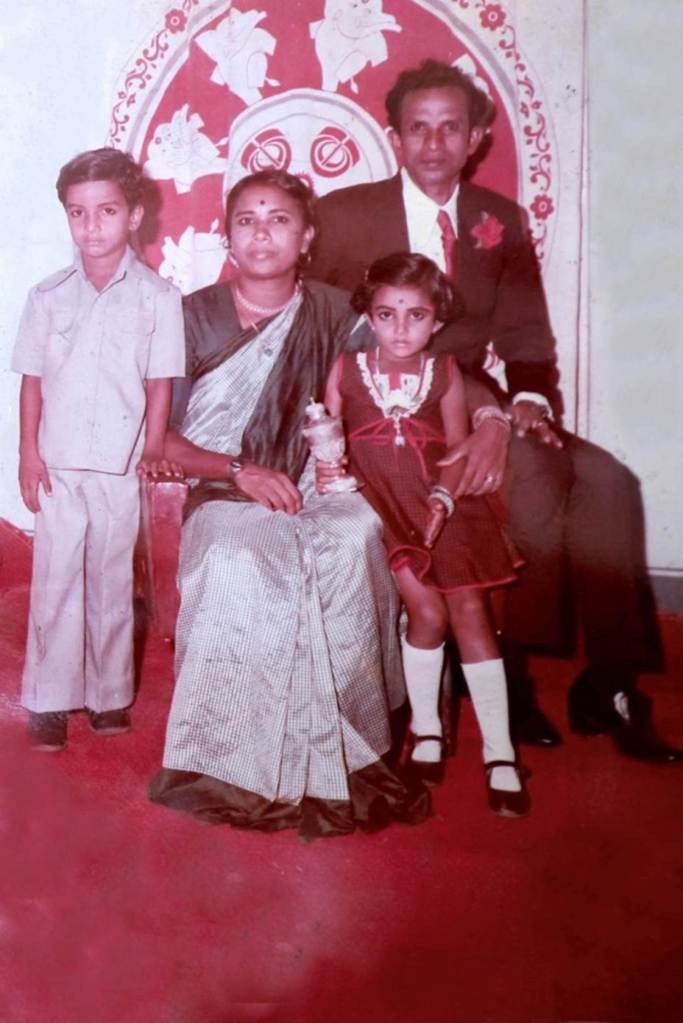
A family photo from 1982
Chapter 8
A man of discipline
If discipline had a face, it would be my father’s. He rose early, completed his daily chores, bathed and groomed himself, exercised, trained, and cared for the animals and the garden. He cycled to work and, after returning home, trained in different sports at the stadium. Day after day, he followed this routine with precision and rigor. He kept his body and mind healthy and energetic, and avoided alcohol and smoking throughout his life.
To him, health was not merely personal; it was a social responsibility. He believed that only a healthy body and mind could serve society for a long time.
From my father, I learned his keen observation that even a small wrinkle or a speck of lint on football stockings could affect the game. He brought that same athletic precision and attention to detail to everything in life. Honesty, leadership, organization, cleanliness, tidiness, and discipline were values he held dear.
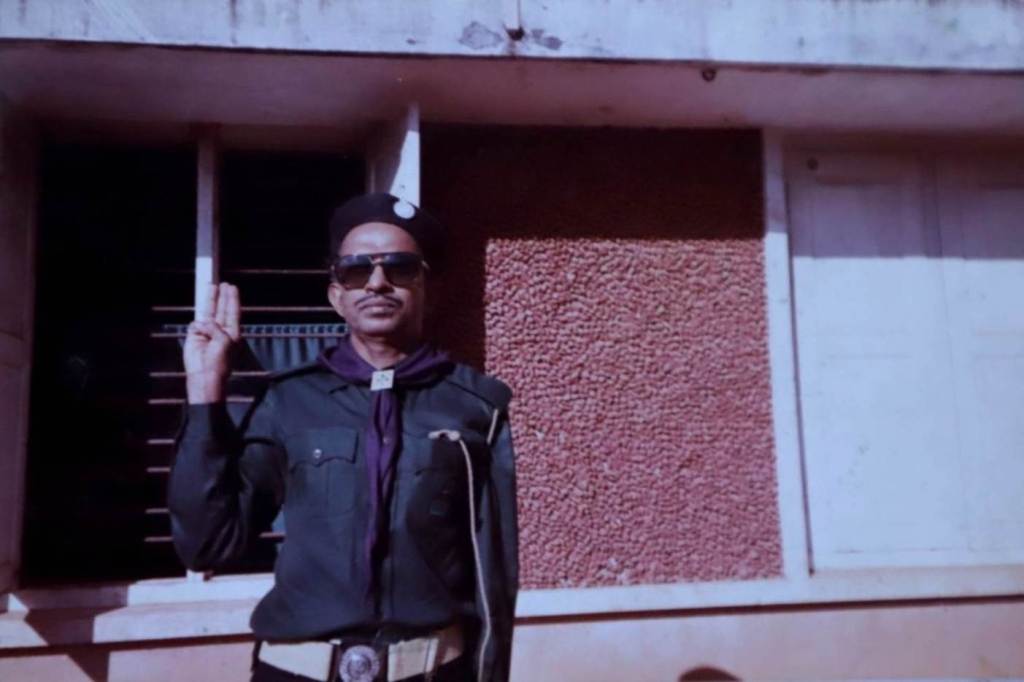
In Bharat Scouts and Guides uniform.
Chapter 9
A man of humor and original thought
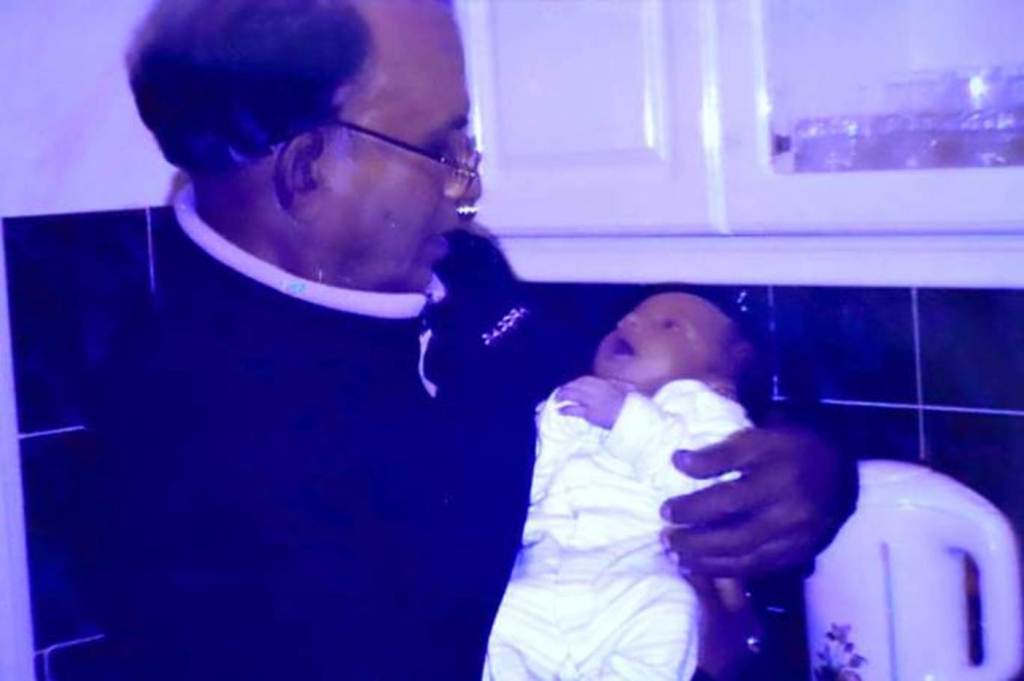
My father with his grandson Siddharth.
Many may have seen my father as a serious man, but those who knew him well recognized his lively sense of humor.
He loved movies and watched films starring MGR, Sivaji Ganesan, and later Rajinikanth with great enthusiasm. My memories of going to the movies with my family remain vivid. He also had a distinctive sense of style and enjoyed choosing beautiful colors and designs for his clothes.
There were times when my father’s determination turned into stubbornness. Once, when my sister Uma was running late for her college admission, he insisted that we leave before Rahu Kalam, the inauspicious period he was always careful to avoid. As we looked for a solution, we found him standing on a chair and turning the clock hands backward. In that moment, he had defeated time and left Rahu Kalam behind!
Chapter 10
Love for dogs
If you want to know a person’s true character, watch how they treat the weak. My father loved animals, especially dogs.
Our dogs—Sanjayan, Maya, August, and Balu—were with us for many years. My father treated them as members of the family. He worried deeply when they were ill and wept when they died.
His care for Sanjayan during the dog’s illness, and the dignity with which he buried him after his death, revealed the depth of my father’s compassion. Once, when he saw a dog hanging from a wall, trapped by its chain, he rushed to rescue it without thinking of whether it might bite him. That compassion for all living beings made him a truly special person.
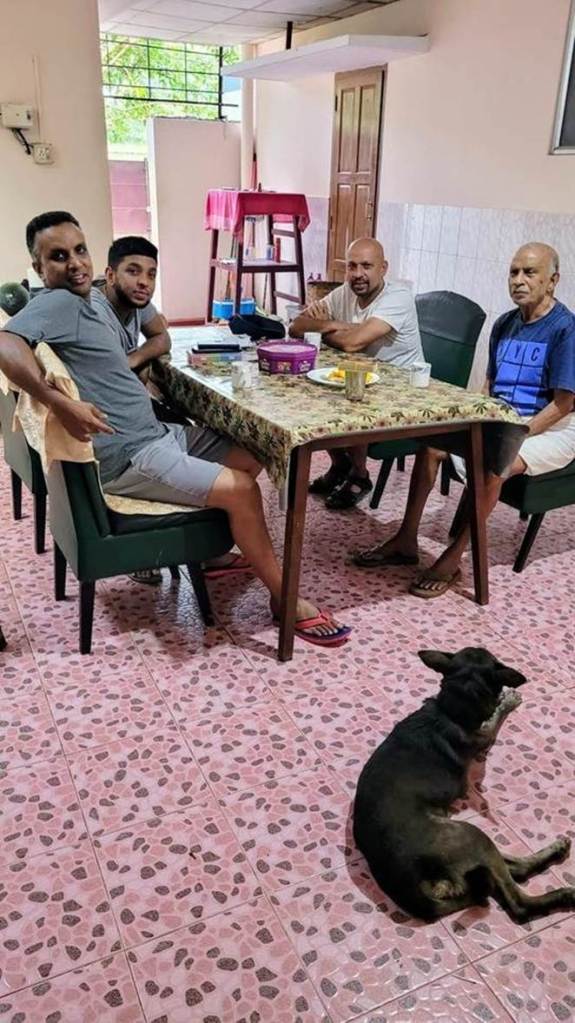
Balu, the dog my father raised, passed away two months before my father.
Chapter 11
A journey toward spirituality
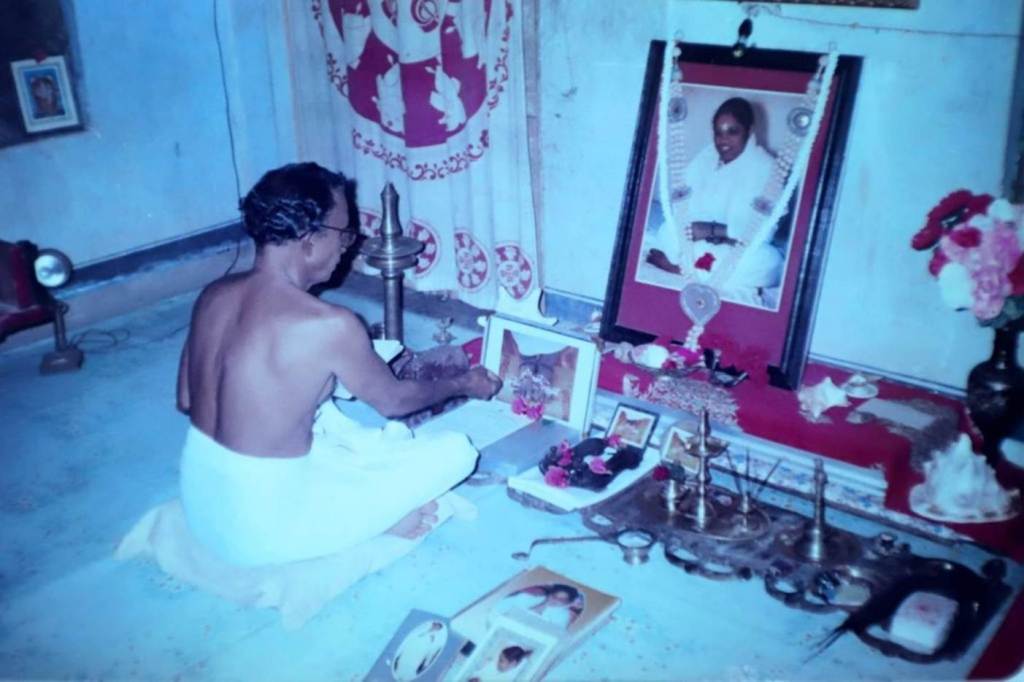
In middle age, my father began another journey. This time, it was not toward sports, but toward self-realization.
A chance meeting with Mata Amritanandamayi brought profound changes to his life. Bhajans (devotional music), satsangs (spiritual discourse), and japa (chanting) became part of his daily routine. His commitment to society did not fade; instead, it gained a deeper spiritual dimension.
Even in his final days, I saw the peace he felt while listening to Amma’s bhajans. In that music, he seemed to forget his tired body and return to a place of quiet refuge.
Chapter 12
My King
The days I spent with him near the end of his life are priceless treasures to me now. He recalled school memories, college stories, old friends, sports competitions, and events from long ago as if they had happened only yesterday.
One day, I played Travancore’s national anthem, Vancheesha Mangalam, for him over the phone. As he listened, his face changed. His eyes slowly closed, his lips trembled, and he sang along softly for a few lines. Then, in a faint voice, he whispered, “My king… my king…”
It was not merely the memory of a king. It was the memory of his childhood, of a world he loved, and above all, the voice of the innocent man within him.
That moment became the title of this book.
Conclusion
My father was not a saint. He was an ordinary man with extraordinary dedication.
He faced defeats, disappointments, and many unfulfilled dreams. Yet he never stopped, because he knew that an honest life is measured not by success, but by effort.
Today, as the wind blows through Sreepaadam Stadium, as those trained at Sree Chitra Coaching School share their stories, as the people he helped remember him, and as my sister, my mother, and I live with his memories, one truth becomes clear: he is not gone.
He continues to live through us and through the values he created and practiced throughout his life. That is why I proudly say today: he was my father, my king.
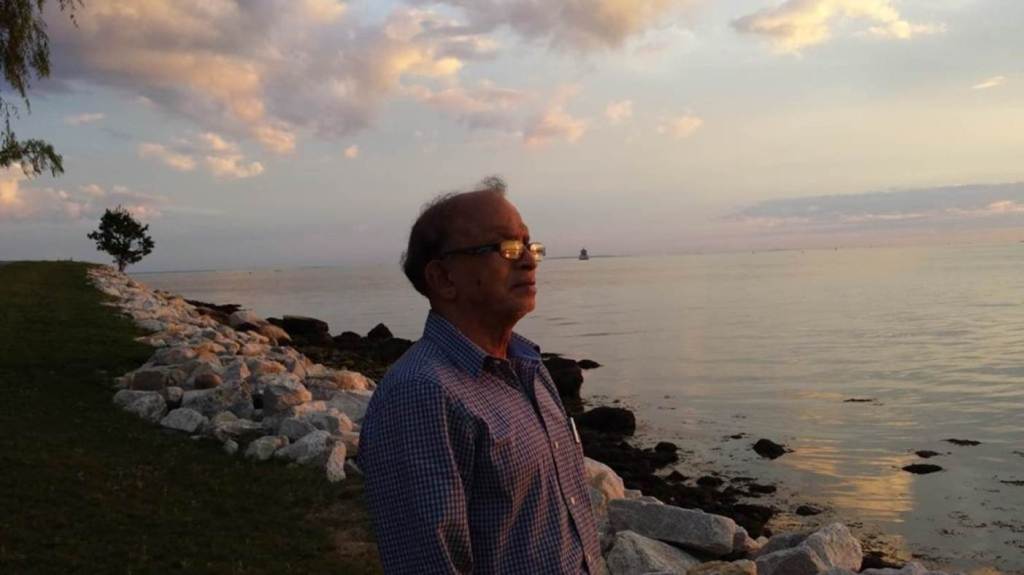
In loving memory of my father.
 Attingal Amateur Athletic Association